
How Dentists Can Reduce Remakes With Better Case Submission
Few things damage a restorative practice more quietly than remakes. A single crown that has to be remade does not just cost the lab fee — it costs an entire seat appointment, the trust of the patient who has to come back, the chair time that displaces another case, and often a second adjustment cycle on top of it. A practice with a 7% remake rate is, in real terms, giving away the equivalent of two full production days a year for every busy operatory. Most dentists never see that number on a report, but they feel it every week.
Remakes are not random. They follow predictable patterns, and the overwhelming majority of them trace back to one place: the case submission. The lab can only work with what it receives. When the scan is incomplete, the bite is unverified, the photographs are missing, or the prescription leaves the technician guessing, the chances of a first-time-fit drop sharply — even at the best lab in the country.
This article breaks down exactly what causes remakes, what a strong case submission looks like, and the specific habits a practice can build to drive its remake rate down toward 1 or 2%. None of these techniques require new equipment or expensive training. They require attention to a handful of details that the busiest practices often skip.
Why Remakes Happen More Often Than Most Dentists Realize
Most dentists believe their remake rate is lower than it actually is. The reason is simple. Remakes that happen at the seat appointment, where the dentist takes a few minutes to grind down a high contact or relieve a tight margin, often do not get logged as remakes at all. They are absorbed into "small adjustments." Cases that come back from the lab with the wrong contour and get sent back quietly are not always tracked. By the time a practice actually measures every adjusted, returned, or refabricated case, the real rate is often two or three times the perceived rate.
Industry data over the last decade has consistently shown that the average traditional analog lab operates at a remake rate of 5 to 10%, with poorly managed cases pushing higher. Digital labs operating end-to-end typically report 1 to 3%. The gap between the two does not come purely from technology. It comes from the discipline that digital workflows force on the case submission process. When the lab cannot proceed without a clean scan and a complete prescription, the practice has no choice but to send a clean scan and a complete prescription. Analog labs, by contrast, can usually start the case with whatever is in the box, and the problems show up at the seat appointment.
Understanding the actual sources of remakes is the first step to eliminating them.
The Top Causes of Remakes
Across thousands of cases reviewed in clinical and lab studies, the same handful of causes account for roughly 80% of all remakes. Recognize them, prevent them, and the rest of the cases tend to take care of themselves.
Incomplete or distorted impressions
In analog workflows, this means tray distortion, drag, voids at the margin, or an impression that pulled away from a deep subgingival prep. In digital workflows, it means an incomplete scan — typically a missing portion of the margin, an interproximal area where the soft tissue obscured the prep, or a bite scan taken without the patient in stable maximum intercuspation.
Even small impression errors compound. A 200-micron void at the margin becomes a 200-micron open margin on the final restoration. The lab can guess at what the missing area looks like, but a guess is exactly the kind of decision that produces a remake.
Incorrect or unverified bite registration
Occlusion is the single largest source of clinically relevant remakes. A case can have a beautiful margin, ideal contour, and excellent contacts, and still be unusable if the bite is wrong. The most common error is a bite that was recorded with the patient slightly forward, slightly to the side, or with the bite pad accidentally compressed during capture.
In digital workflows, the bite is verified the moment the scan finishes. The dentist can rotate the virtual model and confirm the centric stops are landing where they should before submitting the case. Practices that skip that verification step, or that scan the bite without confirming the patient is fully closed, account for a disproportionate share of digital remakes.
Unclear prescriptions
Lab technicians are skilled, but they are not psychic. A prescription that says "crown" does not tell the lab what shade, what material, what reduction the dentist achieved, or what the patient actually wants the restoration to look like. The lab has to make assumptions, and assumptions are often wrong.
A strong prescription answers every question the technician would have asked if there were time for a phone call. Material. Shade. Stump shade for high-translucency restorations. Contact tightness preference. Occlusal scheme. Specific aesthetic notes. The technician should be able to read the prescription and proceed without guessing.
Missing or low-quality photographs
For aesthetic cases, photographs are not optional — they are the single best tool the lab has to match shade, characterize the restoration, and understand what the dentist and patient are trying to achieve. Cases submitted without photographs, or with photographs taken under fluorescent operatory light without a polarized filter or shade tab, regularly come back with shade mismatches that require remakes or extensive chairside characterization.
The fix is straightforward. Standardize the photographic protocol for every aesthetic case, take three to five photos at minimum, and include shade tabs in the same frame as the prep and adjacent teeth.
Soft tissue management at the prep
This one is on the dentist. A prep with bleeding, tissue that has rolled over the margin, or saliva pooling at the gingival line will not produce a clean impression, digital or analog. Hemostatic agents, retraction cord, well-managed sulcus, and a dry field are not optional for a margin that needs to be captured accurately. The fastest way to drive up a remake rate is to scan or impress a prep before the field is properly prepared.
Building a Case Submission Standard for the Practice
Most practices do not have a written standard for case submission. Cases are submitted however the doctor or assistant happens to do it that day. That variability is a major source of inconsistent lab output. The single highest-leverage change a practice can make to reduce its remake rate is to write down what a complete case submission looks like and apply it to every case that leaves the office.
Here is what a strong case submission standard looks like in practice.
A pre-submission checklist for every case
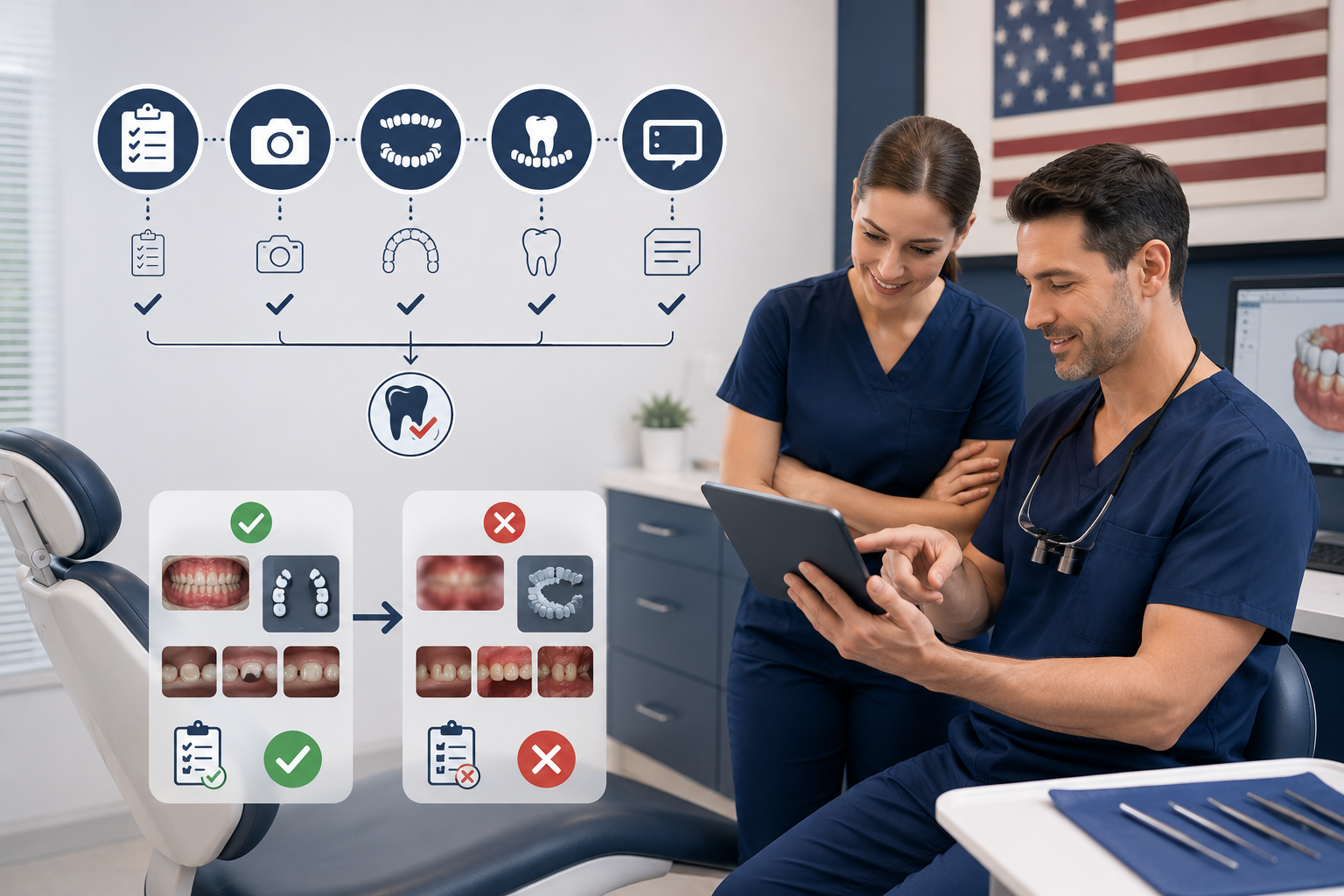
Before any case leaves the office, the assistant or designated team member walks through a checklist. The prep is fully captured with no margin gaps. The opposing arch is scanned in full. The bite is captured with the patient in confirmed maximum intercuspation. Photographs are taken — including a shade tab in frame for aesthetic cases. The prescription is filled out completely with material, shade, contact preference, and any clinical notes. The patient's name and the doctor's name are on the case. Special instructions, if any, are written clearly.
A case that does not pass the checklist does not get submitted. Period. The five minutes the checklist adds at the chair is the cheapest insurance the practice has against a returned case.
Standardized photographic protocol
For every aesthetic case, the practice should capture a minimum set of photographs: a retracted frontal view, a retracted lateral view of the prep, a close-up of the prep with shade tabs, a close-up of the adjacent natural teeth, and at least one photo with cross-polarized lighting if the practice has a polarizing filter. These can be taken in under three minutes with a consistent setup and provide more useful information to the lab than any prescription note.
A consistent shade-taking workflow
Shade is taken before the prep is started. The teeth are clean, hydrated, and lit by natural daylight whenever possible. The shade tab is held next to the tooth, photographed in the same frame, and recorded on the prescription. Shade tabs are replaced every two years because they fade — a small detail that surprises many practices when they finally check.
A template prescription
The practice creates a single prescription template that has fields for every piece of information the lab needs. The team fills it out once at the start of the case and updates it through the prep and seat appointments. No more handwritten case slips with the assistant guessing at the material. No more prescription written from memory after the patient has left.
Communication with the lab before fabrication starts
For any case that is not a routine single-unit crown, the practice should expect a digital design preview from the lab before fabrication begins. The dentist reviews the preview, makes any adjustments, and approves the case in the same software the lab is using. This single habit — adopted consistently — virtually eliminates the surprise factor at the seat appointment.
How a Modern Digital Lab Helps the Practice Catch Errors Earlier
A capable digital dental lab does not just receive cases passively. It validates them. The lab's CAD team should be reviewing every submission within hours of receipt, flagging incomplete scans, missing bite registrations, or unclear prescriptions before the case enters production. That feedback loop is one of the highest-value services a digital lab provides, and it is one of the easiest things to evaluate when you are choosing a partner.
Ask any lab you are considering this question: how often does your team contact us to flag a problem in a case before fabrication begins? A lab that contacts the practice on perhaps 15 to 25% of cases is doing its job — those flags are catching the problems that would otherwise become remakes. A lab that never contacts the practice is either receiving perfect cases (unlikely) or, more often, proceeding without a full validation step.
A digital lab that takes case validation seriously becomes a quality control extension of the practice. The lab catches the missed margin. The lab catches the bite that was scanned at light contact instead of full closure. The lab catches the prescription that says "shade A2" but the photograph shows a tooth that is closer to A3.5. Each of those catches is a remake prevented.
Tracking Your Remake Rate Honestly
You cannot improve what you do not measure. The single most useful number a practice can track on a monthly basis is its true remake rate, defined as any case that required a return to the lab, an unscheduled follow-up appointment, or chairside adjustment exceeding ten minutes. That definition captures cases the dentist might otherwise dismiss as small adjustments.
Track the rate by case type. Track it by lab. Track it by doctor. Patterns emerge fast. One operator's cases come back twice as often as another's. One material consistently has higher first-time-fit than another. One lab's cases regularly need chairside grinding while another's do not. Within three to six months, the practice has the information it needs to standardize what works and eliminate what does not.
A Practice Built on First-Time-Fit Wins
Every practice that has driven its remake rate below 2% has done it the same way. They standardized case submission, partnered with a digital lab that validates every case, and treated the prescription as a critical clinical document rather than an afterthought. The result is not just fewer returned cases. It is calmer schedules, more confident seat appointments, happier patients, and a steadier flow of production through the practice.
Remakes are not inevitable. They are a predictable consequence of variable inputs into a precision process. Tighten the inputs and the outputs become predictable. The practice that wins the next decade of restorative dentistry will be the one that treats case submission as carefully as it treats clinical preparation.
Partner With a Lab That Catches Errors Before They Become Remakes
PROCERAM Dental Digital Lab has built its case validation process around one principle: every case that enters production should be one we are confident will fit the first time. Our CAD team reviews every submission for scan completeness, bite verification, and prescription clarity before any milling or printing begins. When something needs attention, we contact the practice immediately — because catching a problem on day one is the difference between a smooth seat appointment and a remake cycle.
If your remake rate is higher than you would like, or if you are tired of cases coming back that should have been caught earlier, we should talk.
Contact PROCERAM Dental Digital Lab today: Phone: +1 (385) 425-8770 Email: Office@ProceramDentalLab.com Web: www.ProceramDentalLab.com Located in Draper, Utah — serving dentists nationwide.
